Go Back
Cold Storage for Agricultural Products | Fruits and Vegetables.
“Nigeria loses an estimated ₦3.5 trillion annually to postharvest losses and inefficiencies, which largely affect smallholder farmers in the country.” - Senator Abubakar Kyari, Minister of Agriculture and Food Security.
“In Nigeria, post-harvest losses reach around 40% of agricultural produce annually.” - Organisation for Technology Advancement of Cold Chain in West Africa (OTACCWA)
A major reason for these losses is the lack of effective cold storage in the agricultural sector and limited access to cold room facilities. Without proper cold storage for agricultural products, farmers lose a large portion of their produce before it reaches the market.
Cold Storage for Agricultural Products
When you think of cold storage, what comes to mind?
Cold storage refers to the use of temperature-controlled systems to preserve perishable or temperature-sensitive products, such as food, pharmaceuticals, cosmetics, and other items.
These systems include cold rooms, blast freezers, mobile cold rooms or refrigerated trucks, reefers, and others.
To a farmer, cold storage for agricultural products means a refrigerated warehouse or unit where farmers, distributors, and agribusinesses can store perishable goods to keep them fresh, prevent spoilage, and minimize post-harvest losses.
Agricultural Products that Require Cold Storage
Generally, farm produce is prone to spoilage, and so it requires cold room storage. Some of these classes of products include
- Fruits (mangoes, apples, bananas, oranges)
- Vegetables (tomatoes, peppers, carrots, cabbage)
- Dairy (milk, cheese, butter)
- Meat, poultry, and fish
- Seeds and flowers
Using the right cold storage for agricultural products protects them from spoilage and extends their shelf life.
- The temperature requirement is between 0 degrees Celsius and 10 degrees Celsius.
- This type of cold storage is used for fruits, vegetables, and flowers.
- It is ideal for short-term storage and helps maintain freshness.
2. Deep Freezers / Frozen Storage
- The temperature requirement is between minus 18℃ and minus 25℃.
- This cold storage is used for meat, fish, poultry, and frozen vegetables.
- It allows long-term preservation by slowing enzyme activity and preventing spoilage.
3. Controlled Atmosphere (CA) Storage
- It is used for highly perishable produce such as apples, bananas, and avocados.
- It controls oxygen, carbon dioxide, and humidity levels to extend shelf life.
- It helps fruits stay fresh for months without chemical ripening.
4. Modified Atmosphere (MA) Storage
- This form of cold storage in agriculture is mostly used for packaged produce.
- It is similar to controlled atmosphere storage but with less strict control.
5. Refrigerated Transport (Refrigerated Trucks & Containers)
- Refrigerated trucks and containers are an important part of cold storage in agriculture.
- They help maintain the right temperature during transport from the farm to the cold room and from the cold room to the market.
- This is critical for perishable products such as tomatoes, milk, and seafood.
6. Evaporative Cool Storage
- This type of cold storage in agriculture operates at temperatures between 10 degrees Celsius and 15 degrees Celsius and does not require electricity.
- It is suitable for small-scale farmers in rural areas.
- It uses water evaporation to cool produce, such as clay pot coolers and zero-energy cool chambers.
7. Multi-Commodity Cold Storage
- It is a large-scale cold storage in agriculture that can store multiple crops such as fruits, vegetables, and dairy products.
- It is divided into temperature zones for different produce types.
- It is commonly used as a cold storage hub for agricultural clusters.
8. Ripening Chambers
- Ripening chambers are a special form of cold storage in agriculture used for fruits like bananas, mangoes, and tomatoes.
- They control temperature and humidity and use safe ripening agents like ethylene gas.
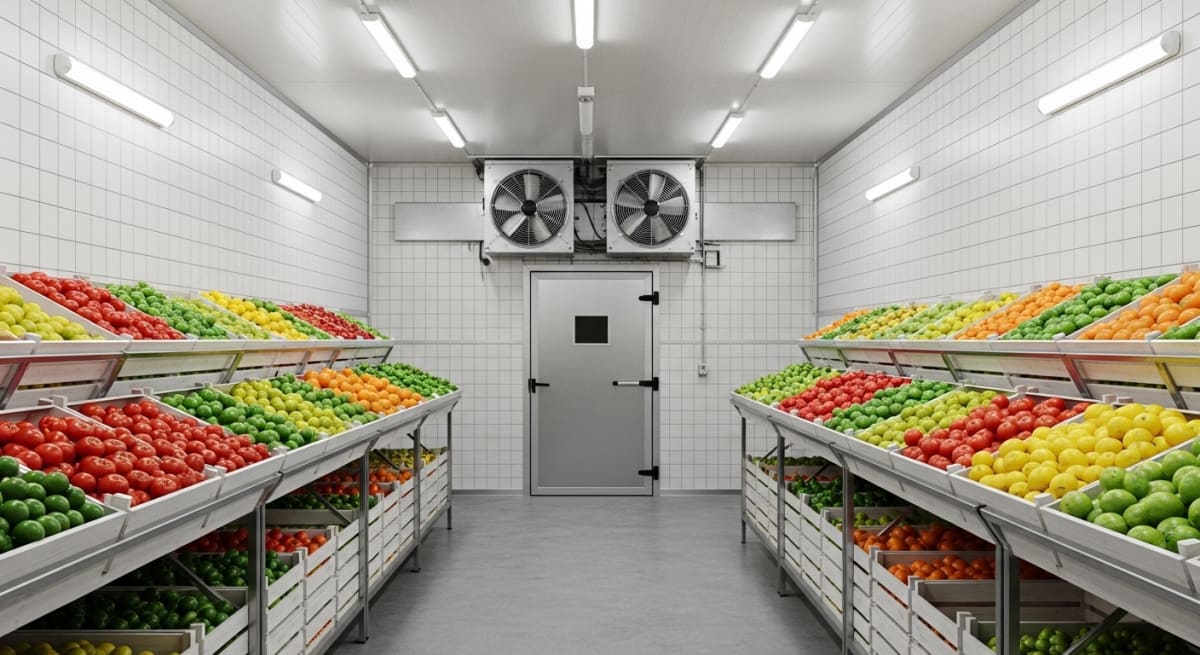
Temperature Range for Fruits and Vegetables
When it comes to cold storage for agricultural produce, different fruits and vegetables require different temperature ranges.
Produce
Temperature range (℃)
Storage life
(Days)
Apple
-1-4
30-180
Avocado
3-13
14-56
Banana/plantain
13-15
7-28
Basil
7-10
7
Breadfruit
13-15
14-42
Cucumber
10-13
10-14
Dates
-18-0
180-360
Eggplant
8-12
7
Ginger
13
180
Grape
-0.5-0
14-56
Grapefruit
10-15
42-56
Guava
5-10
14-21
Horseradish
-1-0
300-360
kiwifruit
-0.5-0
90-150
Lemon
10-13
30-180
Lime
9-10
42-56
Mango
13
14-20
Okra
7-10
7-10
Orange
0-9
56-84
Papaya
7-13
7-21
Passion fruit
7-10
21-35
Peach
-0.5-0
14-28
Pear
-1.5-0.5
60-210
Pepper (bell)
7-13
14-21
Persimmon
-1
90-120
Pineapple
7-13
14-28
Plum
-0.5-0
14-35
Pomegranate
5
60-90
Potato (early)
7-16
10-14
Potato (late)
4.5-13
150-300
Pumpkins
10-15
60-160
Raspberries
-0.5-0
2-3
Sweet potato
13-15
120-210
Tamarind
7
21-28
Tomato (red)
8-10
8-10
Watermelon
10-15
14-21
Yam
16
60-210
Source: Food and Agriculture Organisation (FAO)
Benefits of Cold Storage for Agricultural Produce
The benefits of having cold storage for agricultural produce cannot be overemphasized; it plays a major role in sustaining agriculture.
Some benefits include
- It helps improve the shelf life of agricultural products, as each produce requires a different temperature range.
- It allows farmers and food distributors to preserve and transport perishable goods for longer periods.
- It ensures that consumers have access to fresh and healthy products all year round.
- It reduces the waste of farm produce and revenue loss significantly.
At Flux Logistix Cold Chain, we provide reliable cold storage solutions designed to keep your agricultural produce fresh and safe. Our modern cold rooms and refrigerated trucks help farmers, distributors, and agribusinesses preserve fruits, vegetables, and other perishable goods from farm to market.
We focus on efficiency and careful handling to ensure the right temperature is maintained at every stage. The right cold storage in agriculture can make the difference between profit and loss, especially for temperature-sensitive produce.
If you are looking for cold storage for agricultural produce or need refrigerated transport to move it safely, Flux Logistix offers solutions suited to Nigeria’s climate and power conditions.
Visit our website today to learn more about our cold storage spaces in Lagos and how we can help you reduce post-harvest losses and keep your produce fresh for longer.